


The Sun is the center of our solar system and the source of nearly all life on Earth. It provides the light and heat that make our planet habitable, yet one simple question continues to confuse many people: what color is the sun? Most of us learned from childhood drawings and classroom illustrations that the Sun is yellow. However, modern astronomy tells a different story. The Sun only appears yellow under certain conditions, while its true color is actually white.
Understanding the Sun’s color is more than a fun science fact. It helps explain why the sky is blue, why sunsets are red, and how sunlight travels through Earth’s atmosphere. Scientists have studied the Sun for centuries using telescopes, satellites, and space missions. These observations show that the Sun emits light across the entire visible spectrum rather than producing only one color.what color is the sun? In this article, you’ll discover the real color of the Sun, why it changes appearance throughout the day, how scientists measure its light, and several interesting facts that help explain one of the most common questions in astronomy.
What Is the True Color of the Sun?
The true color of the Sun is white. Although many people believe it is yellow, scientific observations show that sunlight contains all the colors of the visible spectrum.what color is the sun? When these colors combine, they create white light. This is why astronauts viewing the Sun from space describe it as bright white rather than yellow. Outside Earth’s atmosphere, there is nothing to change or scatter the sunlight before it reaches the human eye.
Scientists know this by studying the Sun’s spectrum. Using special instruments called spectrometers, they separate sunlight into individual wavelengths.what color is the sun? The results show that the Sun produces red, orange, yellow, green, blue, indigo, and violet light. Because these colors are emitted together in nearly balanced amounts, our eyes naturally interpret the combined light as white. This is also why sunlight passing through a prism creates a rainbow, revealing all the colors hidden within white light.
Why Does the Sun Look Yellow from Earth?
Even though the Sun is white, it often appears yellow when viewed from Earth’s surface. This happens because our atmosphere affects the way sunlight travels.what color is the sun? As sunlight enters the atmosphere, tiny gas molecules scatter shorter wavelengths of light, especially blue and violet. This process is called Rayleigh scattering and plays a major role in determining how the Sun appears to us.
Since much of the blue light is scattered in different directions before reaching our eyes directly, the remaining sunlight contains proportionally more red and yellow wavelengths.what color is the sun? As a result, the Sun often looks pale yellow during the middle of the day. Atmospheric conditions such as humidity, dust, smoke, and pollution can make this effect stronger, causing the Sun to appear even more golden or slightly orange depending on the weather.
Why Does the Sun Change Color During Sunrise and Sunset?
The Sun looks most colorful during sunrise and sunset because its light travels through a much thicker layer of Earth’s atmosphere.what color is the sun? When the Sun is low on the horizon, sunlight must pass through far more air than it does when the Sun is directly overhead. Along this longer path, most of the shorter blue and green wavelengths are scattered away before reaching the observer.
Only the longer red, orange, and some yellow wavelengths continue through the atmosphere in significant amounts. This creates the beautiful orange and red colors that people often enjoy at dawn and dusk.what color is the sun? On days with extra dust, smoke, or tiny water droplets in the air, sunsets can become even more vibrant because additional particles increase the scattering of shorter wavelengths while allowing warmer colors to dominate the sky.
How Does the Sun Produce Light?
The Sun produces light through a process called nuclear fusion. Deep inside its core, enormous pressure and temperatures exceeding 15 million degrees Celsius force hydrogen atoms to combine into helium.what color is the sun? During this reaction, a small amount of mass is converted directly into energy according to Einstein’s famous equation, E = mc². This energy eventually reaches the Sun’s surface and radiates into space as light and heat.
The energy created in the core takes thousands to hundreds of thousands of years to slowly move through the Sun’s dense interior before finally escaping from its visible surface, known as the photosphere.what color is the sun? Once released, sunlight travels through space at the speed of light and reaches Earth in about eight minutes and twenty seconds. This constant flow of energy supports weather systems, plant growth, and nearly every ecosystem on our planet.
What Is White Light and Why Is It Important?
White light is a combination of all the visible colors mixed together. Although people often think of white as a single color, it is actually made from many different wavelengths of light.what color is the sun? When sunlight passes through a glass prism or tiny water droplets in the atmosphere, each wavelength bends slightly differently, separating into the familiar rainbow of colors.
This property of white light has helped scientists understand the composition of the Sun and many other stars. By studying the spectrum of sunlight, researchers can identify the chemical elements present in the Sun’s atmosphere, including hydrogen, helium, oxygen, carbon, iron, and several other elements.what color is the sun? Spectroscopy has become one of the most important tools in modern astronomy because it allows scientists to study distant stars without physically visiting them.
Why Is the Sky Blue If the Sun Is White?
One of the most fascinating results of sunlight interacting with Earth’s atmosphere is the blue sky. Since sunlight contains every visible color, the atmosphere scatters the shorter blue wavelengths much more effectively than the longer red wavelengths. As this scattered blue light spreads across the sky, it reaches our eyes from every direction, making the entire daytime sky appear blue.
Violet light is actually scattered even more than blue light, but human eyes are less sensitive to violet wavelengths, and some violet light is absorbed by the upper atmosphere. As a result, blue becomes the dominant color we see. This same scattering process also explains why the Sun itself appears slightly yellow during the day, since some of its blue light has already been redirected throughout the sky.
How Do Scientists Know the Sun Is White?
Scientists have confirmed the Sun’s true color using observations from both Earth and space. Spacecraft, satellites, and astronauts observe the Sun without interference from Earth’s atmosphere. These observations consistently show that the Sun appears white when viewed directly from space. Instruments aboard solar observatories also measure the Sun’s complete light spectrum with remarkable precision.
Scientists also use the concept of a blackbody radiator to understand the Sun’s light. The Sun’s surface temperature is approximately 5,500 degrees Celsius, or about 5,778 Kelvin. Objects at this temperature naturally emit radiation across a wide range of wavelengths. Although the Sun’s strongest emission is near the green portion of the spectrum, it emits enough red and blue light alongside green that the combined result is perceived as white by the human eye.
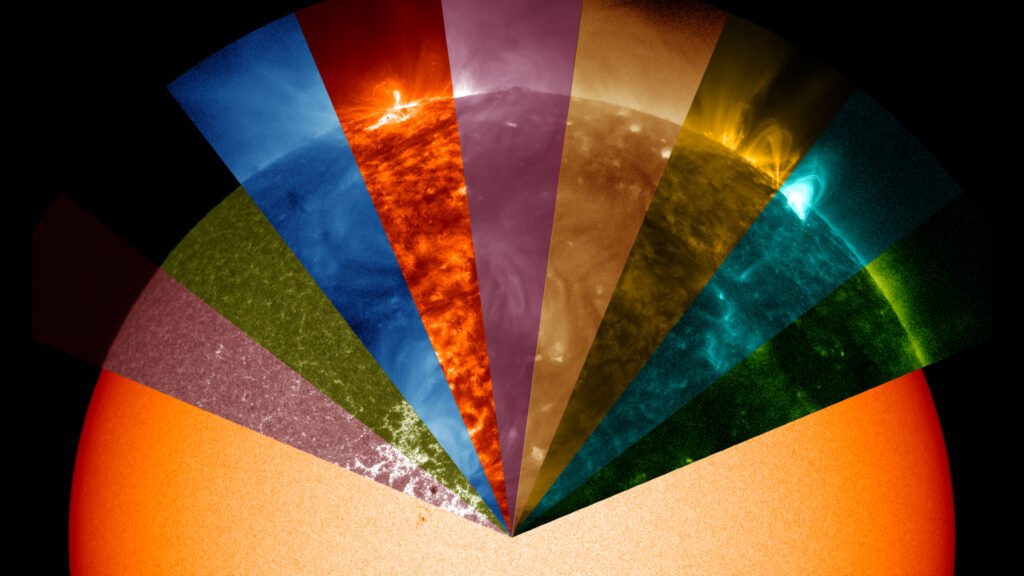
Does the Sun’s Color Mean It Is Different from Other Stars?
The Sun belongs to a category of stars known as G-type main-sequence stars. These stars have moderate surface temperatures compared with cooler red stars and hotter blue stars. Although the Sun is often nicknamed a “yellow dwarf,” this name can be misleading because it refers to its classification rather than its actual appearance in space.
Stars display different colors because their surface temperatures vary greatly. Cooler stars emit more red light, while extremely hot stars emit more blue light. The Sun falls between these extremes, producing a balanced spectrum of visible light. This balanced emission gives the Sun its white appearance, making it one of the many stars whose true color differs from popular descriptions based on observations made from Earth’s surface.
Common Misunderstandings About the Sun’s Color
Many people believe the Sun has recently changed from yellow to white, but this is not true. The Sun has maintained a stable appearance for billions of years. The growing belief that the Sun is white comes from improved scientific education and clearer photographs taken by satellites and astronauts outside Earth’s atmosphere. These images show the Sun without atmospheric effects, allowing people to see its natural color.
Another common misunderstanding is that the Sun is green because its spectrum reaches maximum intensity near green wavelengths. While this statement is technically correct, it does not mean the Sun appears green. Since it emits large amounts of red and blue light at the same time, all the visible colors blend together into white. Human vision naturally combines these wavelengths, preventing the Sun from appearing green despite the location of its spectral peak.
Conclusion
The answer to the question “What color is the Sun?” is both simple and fascinating. Scientifically, the Sun is white because it emits light across the entire visible spectrum. Every color of the rainbow is present in sunlight, and when these colors combine, they produce white light. The familiar yellow appearance that we see from Earth is caused by the scattering of blue light in our atmosphere, while the rich reds and oranges of sunrise and sunset result from sunlight passing through a thicker layer of air.
Learning about the Sun’s true color also helps us understand many everyday natural phenomena, including blue skies, colorful sunsets, rainbows, and the behavior of light itself. Decades of research, space exploration, and advanced scientific instruments have confirmed that the Sun’s color does not change; only our view of it changes depending on atmospheric conditions and the position of the Sun in the sky. Although the yellow Sun remains a familiar symbol in art and culture, the scientific reality is even more remarkable. The Sun is a brilliant white star whose light powers our planet and continues to reveal the fascinating laws of physics that govern the universe.
